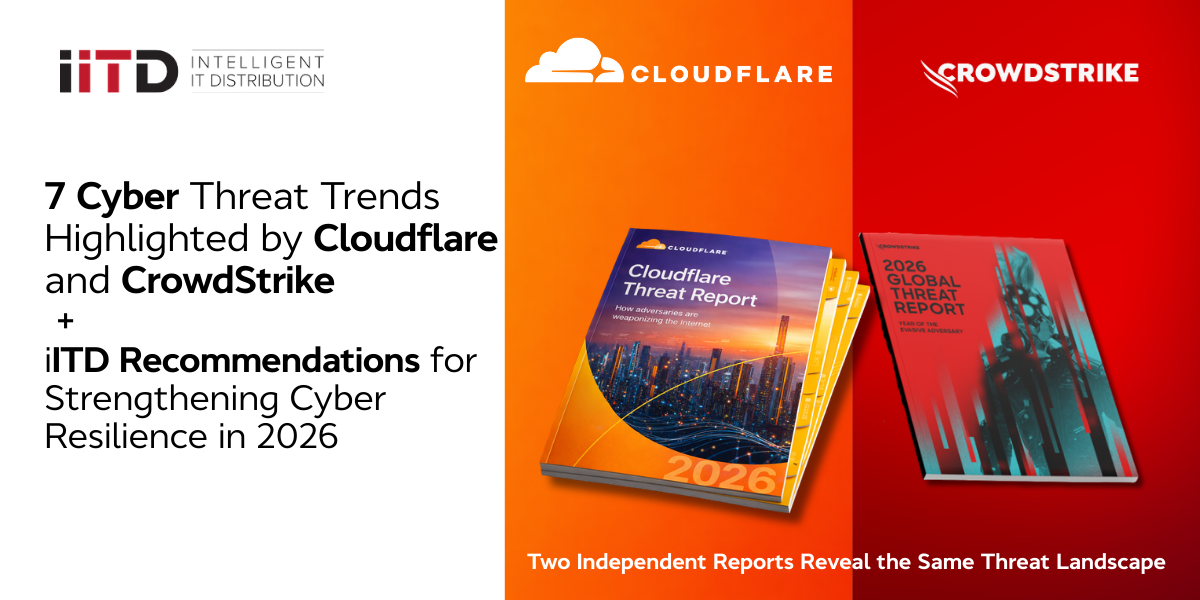
The Cloudflare Threat Report 2026 and CrowdStrike Global Threat Report 2026 show that the modern threat landscape is defined by AI-driven attack automation, the growing role of identities and SaaS services within corporate infrastructure, as well as large-scale DDoS attacks and complex multi-vector intrusions.
To effectively counter these threats, organizations must shift from a traditional reactive security model—focused on post-incident response—to a proactive, identity-centric cyber resilience model based on early threat detection.
1. Secure AI usage within the organization
Artificial intelligence is becoming a core part of business operations, while simultaneously introducing a new attack surface. Organizations need to control how employees use AI tools, prevent sensitive data leakage in model prompts, and protect internal AI systems from attacks such as prompt injection or data exfiltration.
What to implement:
• Data Loss Prevention (DLP) policies for AI prompts
• access control for AI tools
• auditing of AI service usage
• protection of internal AI models and their infrastructure
Solutions:
Cloudflare Gateway
Cloudflare Data Loss Prevention
Cloudflare Browser Isolation
Falcon AI Detection and Response (AIDR)
2. Adopt a Zero Trust model for application access
Organizations should adopt a Zero Trust model in which access to corporate applications is granted only after verifying user identity, device posture, and connection context. This approach reduces the risk of account compromise and ensures secure access even if passwords or tokens are stolen.
What to implement:
• phishing-resistant MFA
• passwordless authentication
• continuous session monitoring
• least privilege principle
Integration between Cloudflare Access and the CrowdStrike Falcon Platform enables device posture verification before granting access to corporate resources.
Solutions:
Cloudflare Access
CrowdStrike Falcon Identity Protection
3. Strengthen SaaS integration security
SaaS integrations have become critical to business operations but also introduce new risks. The compromise of a single API token or integration can allow attackers to move laterally across multiple systems.
What to implement:
• auditing SaaS API access
• access token management
• monitoring anomalous activity in SaaS environments
• least privilege principle
Solutions:
Cloudflare CASB
CrowdStrike Falcon Cloud Security
4. Eliminate blind spots between security systems
Most modern attacks unfold across multiple stages: initial access via web or email, compromise of a user device, and lateral movement within the infrastructure. When these events are analyzed in isolation by different security systems, organizations may miss the full picture of an incident.
Therefore, it is critical to correlate data from network services and endpoint devices for centralized analysis. The combination of Cloudflare Security Analytics and CrowdStrike Falcon XDR enables faster detection of complex multi-stage attacks, provides full incident visibility, and improves the effectiveness of security response teams.
Solutions:
Cloudflare Security Analytics
CrowdStrike Falcon XDR
5. Secure the software supply chain
Attacks targeting the software supply chain are becoming increasingly common. Adversaries can introduce malicious code through third-party libraries, CI/CD pipelines, or code repositories.
What to implement:
• dependency validation
• CI/CD pipeline security controls
• code signing
• third-party risk assessment
Solutions:
CrowdStrike Falcon Cloud Workload Protection
CrowdStrike Falcon Shield
6. Strengthen edge and web security
Phishing, malicious domains, and compromised web resources remain among the most common initial access vectors. To reduce this risk, organizations must control user web traffic and block suspicious resources at the network level before they reach corporate systems.
Combining Cloudflare Gateway, which filters traffic and restricts access to malicious sites, with CrowdStrike Falcon Insight, which detects suspicious activity on endpoints, provides layered protection against web-based threats. This approach helps block malicious traffic before it reaches user devices and reduces the risk of infrastructure compromise.
Solutions:
Cloudflare Gateway
CrowdStrike Falcon XDR
7. Implement automated DDoS protection
New botnets are capable of generating DDoS attacks exceeding tens of Tbps, making manual response ineffective. Organizations must adopt automated protection systems capable of detecting and mitigating attacks in real time at the level of global network infrastructure.
Solutions:
Cloudflare DDoS Protection
8. Strengthen user and remote workforce verification
With the widespread adoption of remote work, organizations need to implement additional user verification mechanisms to reduce the risk of insider threats and identity-based attacks.
What to implement:
• multi-factor identity verification
• biometric authentication
• access control for corporate devices
Solutions:
Cloudflare Access
9. Leverage global threat intelligence for early detection
Adversaries continuously evolve their tactics and infrastructure. Without access to up-to-date threat intelligence, organizations often detect attacks too late. Therefore, leveraging threat intelligence is critical for early identification of attacks and indicators of compromise (IOCs).
The combination of Cloudflare Cloudforce One and CrowdStrike Falcon Intelligence provides real-time insights into adversary activity and emerging threats.
Solutions:
CrowdStrike Falcon Intelligence
Cloudflare Cloudforce One
10. Strengthen employee cyber resilience
The human factor remains a critical element of cybersecurity. Training employees to recognize phishing attempts, social engineering techniques, and other attack methods helps prevent incidents at early stages.
11. Build a layered cybersecurity architecture
Modern cyberattacks rarely rely on a single vector. They often begin with phishing emails or malicious web resources, continue with the compromise of user devices, and evolve into lateral movement within corporate infrastructure.
In response, organizations must adopt a layered security model in which multiple protection mechanisms operate as a unified system.
A reference architecture combining Cloudflare and CrowdStrike demonstrates how this model can be implemented in practice. The Cloudflare One platform provides network protection, Zero Trust access control, and edge-level traffic filtering. At the same time, the CrowdStrike Falcon platform delivers endpoint protection, behavioral monitoring, device posture assessment (Zero Trust Assessment), and threat detection within internal environments.
The integration of these platforms creates a unified security ecosystem with bidirectional data exchange between network and endpoint layers. For example, Cloudflare’s network telemetry and security events can be ingested into Falcon Next-Gen SIEM, enabling analysts to correlate network activity with specific endpoint behavior. In parallel, device posture insights from CrowdStrike can be used by Cloudflare to enforce access decisions within Zero Trust policies.
This approach provides comprehensive visibility across the infrastructure, improves detection of complex multi-vector attacks, and enables automated response. For instance, a threat detected on an endpoint can automatically trigger network access restrictions via Cloudflare, while network-based indicators of compromise can initiate automated response workflows in CrowdStrike Falcon Fusion SOAR.
As a result, the combined capabilities of Cloudflare and CrowdStrike enable a layered cybersecurity architecture that spans network security, endpoint protection, and application access. This integrated model enhances visibility, reduces response time, and strengthens the overall protection of corporate environments.
Figure 1: High-Level Architecture — Integration

 Ukraine
  Azerbaijan
  Estonia
  Latvia
  Lithuania
  Kazakhstan
  Poland
  Uzbekistan