EDR False Positives: Certificate Triage With Censys- image 1

EDR False Positives: Certificate Triage With Censys

The article is also available at:
Ukrainian, Azerbaijani, Russian

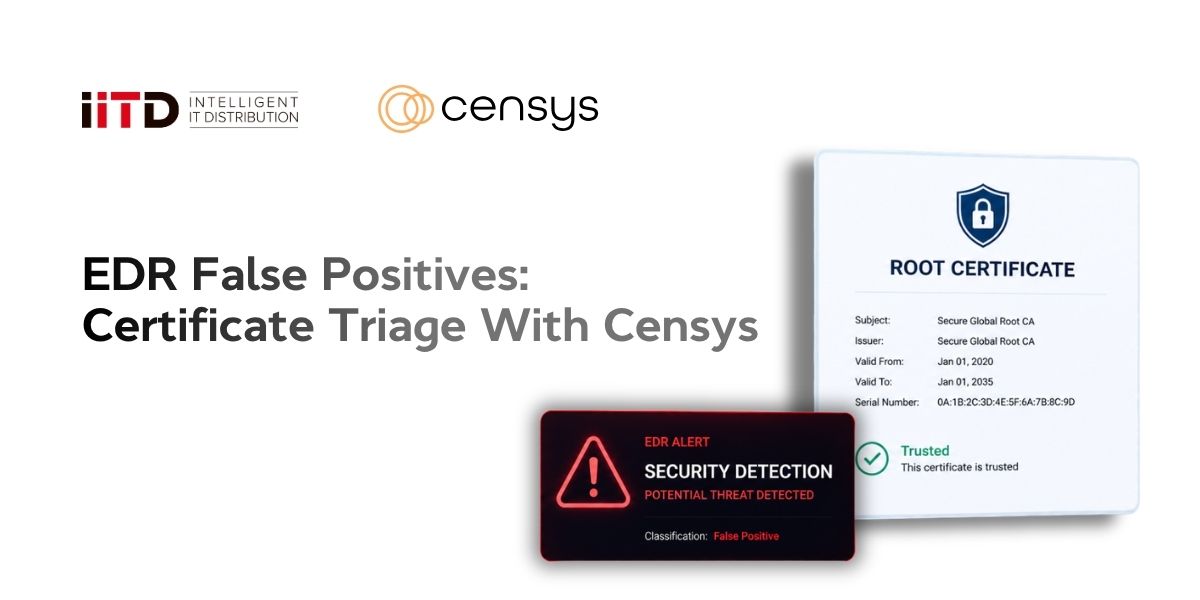
On May 3, 2026, Windows administrators and security analysts faced mass alerts from Microsoft Defender reporting the threat Trojan:Win32/Cerdigent.A!dha.

The system identified legitimate DigiCert root certificates as malware, causing their isolation and disruption of trust chains in corporate infrastructure. Such systematic errors of endpoint scanning tools pose critical risks to the continuity of business processes. Solving the problem requires specialists to instantly distinguish a targeted attack from a false detection based on the real picture of the global network.

EDR False Positives: Certificate Triage With Censys - image 1
ISSUE

Risks of False Certification Labeling

Certificates in .cer, .crt, or .pem formats are fundamentally different from classic malware as they are non-executable and do not create hidden processes in memory. In the Windows environment, these files form the foundation of the digital trust architecture. Cybercriminals indeed use stolen or forged certificates to mask malicious code and deploy Command & Control. However, in the case of a false isolation of a valid root certificate, the antivirus massively blocks legitimate connections.

Analysts face the non-obvious task of determining the physical presence of the file, its impact on validation processes, and the reason for its appearance, without blindly relying on the local verdict of protection tools.

SOLUTION

Global Analytics of x.509 Documents

To quickly confirm or refute alerts, a reliable and independent verification source, such as the Censys platform, is needed.

The company offers access to the largest database of cryptographic information, numbering over 15 billion certificate records. Instead of fruitless attempts to gather details piece by piece, the SOC team receives comprehensive and structured context from Censys: dissected fields, validations in major trust stores, and Certificate Transparency history. This allows for the anonymization of unclear hashes and transforms chaotic analysis into a systematic logical process based on reliable facts in just a few seconds.

TRIAGE PROCESS

Answers to Critical Questions

During the May incident with certificates 0563B8630D62D75ABBC8AB1E4BDFB5A899B24D43 and DDFB16CD4931C973A2037D3FC83A4D7D775D05E4, the Censys database clearly identified them as legitimate DigiCert Assured ID Root CA and DigiCert Trusted Root G4.

The engineer’s workflow in such scenarios is built on a clearly defined checklist:

  • First, determine the hierarchy of the file — records confirmed that these are root certification centers with self-signed behavior.
  • Second, check the network revocation status, which was negative.
  • Third, the system shows the document status on a global level: both identifiers were consistently recognized as valid in the key trust stores of Microsoft, Apple, NSS, and Chrome.
NETWORK CONTEXT

Evidence Base for SOC

The most important stage of a complete investigation remains checking the active presence of the certificate in open internet connections. A specific target query to Censys hosts confirmed the presence of about 2100 online servers publicly using these hashes in their transitional protocol validation chains. This statistic does not reflect the absolute maximum spread but serves as undeniable evidence that the objects belong to ordinary and transparent infrastructure rather than a shadow segment. The presence of such an external informational background is a decisive factor that allows internal teams to cancel the protection system’s prescription and restore the normal functioning of corporate devices.

Critical errors in security systems will remain an inalienable attribute of any extensive digital network’s operation. However, specialists’ ability to quickly verify technical indicators through global analytics helps avoid infrastructure paralysis. Reliable external context does not cancel the basic necessity of checks but makes them quick, accurate, and definitive.

iIT Distribution, as a distributor of cybersecurity solutions, provides confident support at all stages of developing modern protection architectures. The iITD team assists partners in integrating advanced analytical platforms into daily workflows, offering deep technical expertise, training for specialists, and a full cycle of support for projects of any complexity.

News

Current news on your topic

All news
All news