Protecting Accounts Against ShinyHunters Attack Patterns- image 1

Protecting Accounts Against ShinyHunters Attack Patterns

The article is also available at:
Ukrainian, Azerbaijani, Kazakh, Russian

On April 11, 2026, an incident occurred that fundamentally reshaped the understanding of supply chain security: more than 80 million Rockstar Games records were exposed publicly under the ShinyHunters brand. The initial point of entry was not the developer’s internal infrastructure, but the Anodot SaaS analytics platform.

Threat actors used stolen authentication tokens from that third-party service to access the targeted data processing systems. This case definitively proved that compromise through trusted channels can bypass traditional security controls, forcing organizations to rethink how they monitor accounts.

Protecting Accounts Against ShinyHunters Attack Patterns - image 1
Systemic Threat

The illusion of security after successful authentication

When analyzing high-profile data breaches over recent years, experts are seeing a clear repetition of methods despite changes in targets and platforms. In 2024, Snowflake customers were impacted through the use of credentials harvested by infostealers as far back as 2020.

In August 2025, the infrastructure of many Salesforce users was compromised through stolen OAuth tokens from the Salesloft Drift service, and in November of the same year, a similar situation involved Gainsight tokens, affecting more than 200 isolated instances. All of these incidents share a common denominator: different entry points and different providers, but exactly the same outcome — the threat actor gains valid access and establishes a foothold in the environment.

The problem is that viewing ShinyHunters as a single hacking group is misleading. It is merely a brand used at the point of ransom extortion, while the real threat lies in the pattern of activity itself. Cybercriminals use different skill sets to gain access, ranging from purchased password logs to social engineering designed to reset multi-factor authentication. Tracking the specific indicators of one group causes organizations to lose focus, when the real priority should be detecting behavioral anomalies tied to compromised accounts.

Anatomy of the Intrusion

Four stages of saas environment compromise

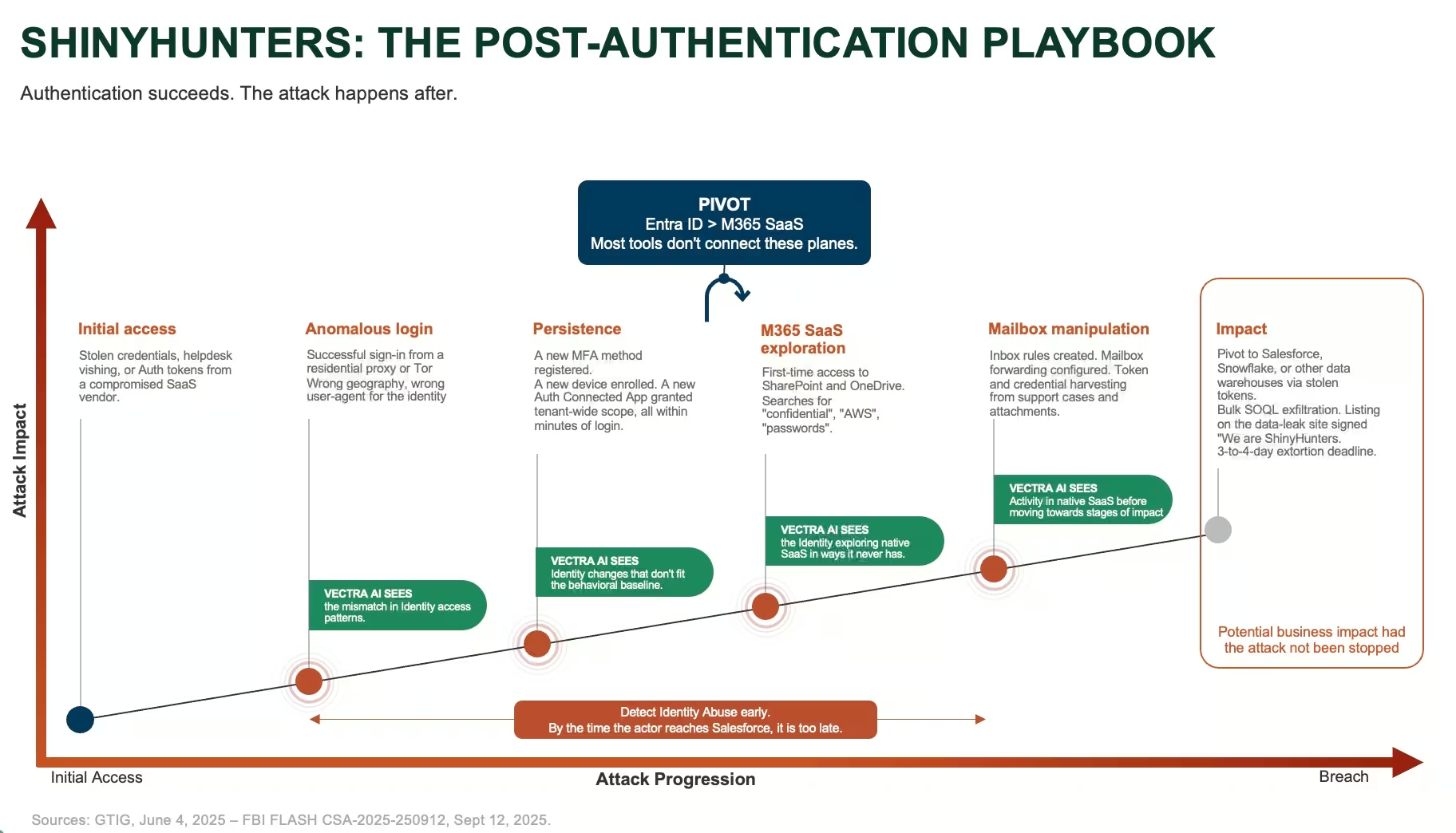
Regardless of the initial compromise method, the attack pattern consists of four sequential stages. Most public reporting focuses on the final platforms from which data is stolen, but the path consistently runs through account management systems such as Microsoft 365, where anomalous activity first becomes visible.

  1. Access: A successful login occurs using valid credentials or tokens. The connection may originate from an unusual location, route through VPN infrastructure, or come from Tor exit nodes, yet the baseline system still treats it as legitimate activity.
  2. Establish: In the first minutes after login, the threat actor secures persistent presence by registering new devices, adding additional methods to bypass verification, and granting permissions to third-party applications.
  3. Expand: The compromised account begins interacting at scale with SharePoint environments or OneDrive directories it has never accessed before, while executing active search queries.
  4. Exfiltrate: Only after building an understanding of the internal architecture does the actor begin targeted data extraction from downstream systems.
Protecting Accounts Against ShinyHunters Attack Patterns - image 2
Real-World Scenarios

Attack deployment vectors through trusted channels

A closer look at these campaigns shows how one behavioral pattern is executed through different attack vectors. The first scenario involves the use of previously stolen credentials, where the system records a login from an unknown device, yet the session fully imitates legitimate behavior. In these circumstances, static access rules function as designed, and threat detection becomes possible only through careful analysis of the speed and nature of post-login activity.

Another illustrative example is the abuse of trusted extensions through OAuth compromise. In analytics service use cases, organizations often grant broad privileges to third-party applications in order to streamline workflows. When the infrastructure of those vendors is breached, cybercriminals obtain high-privilege tokens and operate as a trusted internal company resource. In both cases, the ultimate outcome depends on whether the security system can respond to atypical actions performed by “verified” users.

Behavioral Analytics

Closing blind spots in the secops architecture

Baseline cyber hygiene recommendations remain essential, but modern attacks are engineered specifically to bypass those barriers. Vectra AI emphasizes that traditional detection tools have not lost their effectiveness — they are simply incomplete, because they focus exclusively on events that occur before successful authentication. Modern architectures built on the Zero Trust model require continuous oversight to determine whether current activity aligns with the user’s established profile.

Specialized solutions from Vectra AI make it possible to detect threat actor activity after successful login, operating in the blind spot left behind by classic security controls. Cross-platform analytics automatically correlates data across different environments, transforming fragmented allowed events into a clear chain of suspicious activity. That enables security teams to isolate threats quickly, before critical data exfiltration begins.

In summary, focusing on specific groups or isolated indicators is a conceptual mistake. The strategic value of modern defense lies in changing the trust model: successful authentication no longer guarantees operational security. The true line of defense is the ability to detect behavioral anomalies in real time.

iIT Distribution is an official distributor of Vectra AI solutions and provides partners and customers with expert support at every stage of security project delivery. The iITD team helps select the right tools for behavioral analytics, designs solution architectures aligned with the Zero Trust model, and conducts resilience assessments of enterprise SaaS environments. The company’s specialists serve as a trusted extension of the partner team, delivering high-level guidance from initial needs assessment through full-scale implementation of cyber threat defense systems.
News

Current news on your topic

All news
All news