The quality, consistency, and context of data directly affect both costs and the final business outcome. Being ready for AI starts with data readiness, not with choosing a specific model or platform.
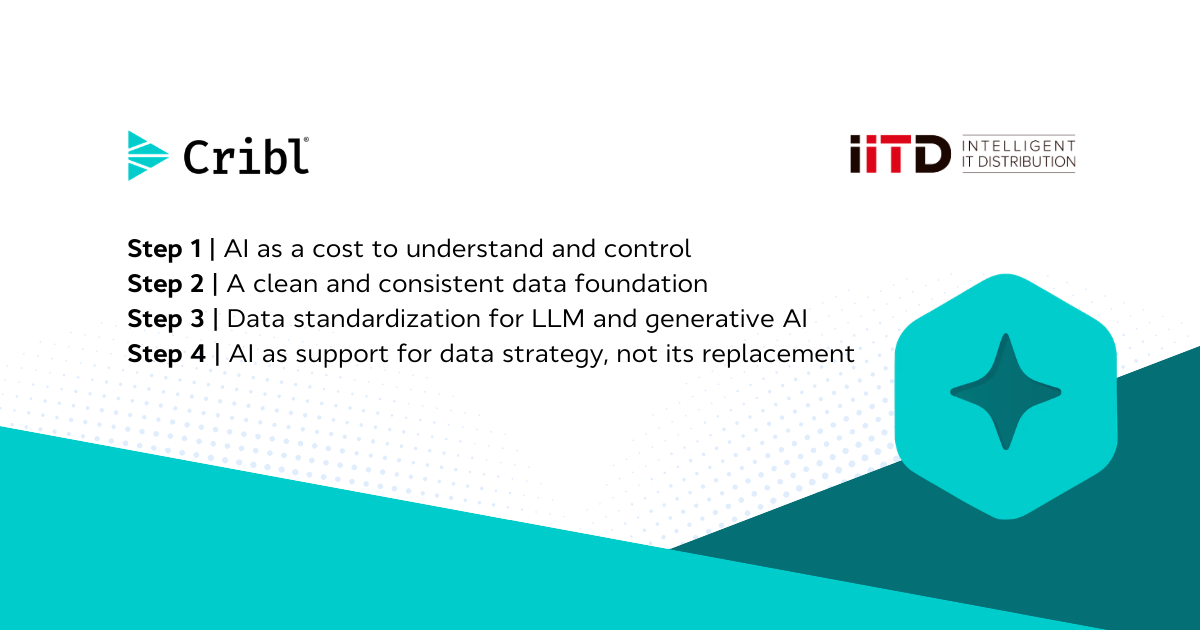
Step 1: AI as a cost to understand and control
One of the most common mistakes is treating AI as a technology that will “defend itself” economically. In the early stage, many initiatives seem cheap or even free, especially when using cloud-based tools. In practice, however, costs start to rise quickly – alongside the number of models and the volume of data.
Therefore, the first element of a mature AI data strategy is full visibility and understanding of how artificial intelligence is used within the organization and what costs it generates. It means consciously monitoring infrastructure, models, and associated data before expenses spiral out of control. In this area, Cribl Stream and Cribl Lake play a key role by enabling the collection and centralization of telemetry from the entire AI environment. This allows teams not only to analyze costs but also to assess which initiatives truly bring business value.
Step 2: A clean and consistent data foundation
Another challenge most AI projects face is data quality. Many initiatives start with inconsistent logs, metrics, and events from different systems. These data often vary in format, field naming, or time marking, leading to incorrect conclusions and unpredictable outcomes.
For AI to function effectively, data must be appropriately prepared before it enters the models. This means standardizing, normalizing, and enriching them with additional context that gives them meaning. Only data that is consistent and understandable can become a solid foundation for further automation and AI-based analytics.
Step 3: Data standardization for LLM and generative AI
Language models and generative AI particularly highlight the problem of lacking data standardization. If data from different sources is not consistent, even simple business questions can lead to inconsistent or incorrect answers. In practice, this means LLMs should not work on raw data streams but on standardized, well-described datasets.
When data is previously unified and stored in a scalable repository, such as Cribl Lake, it becomes possible to safely and controllably share them with AI. As a result, questions posed to models are repeatable, and results are easy to verify and automate. This stage ultimately determines whether AI becomes genuine operational support.
Step 4: AI as support for data strategy, not its replacement
The most mature organizations are now using AI not only for data analysis but also for improving their data strategy itself. Artificial intelligence can help identify gaps in telemetry, point out incomplete data sources, and signal areas needing better informational coverage.
In this model, AI does not replace operational teams but supports them, helping to make quicker decisions and focus on tasks with the highest business value. This approach perfectly aligns with the philosophy of Cribl, in which control over data and its quality remains with the organization.

 Ukraine
  Azerbaijan
  Estonia
  Latvia
  Lithuania
  Kazakhstan
  Poland
  Uzbekistan